Vol. 1 No. 3 (2025): Norms, Knowledge, and Youth in Transition: Interdisciplinary Perspectives from East Asia
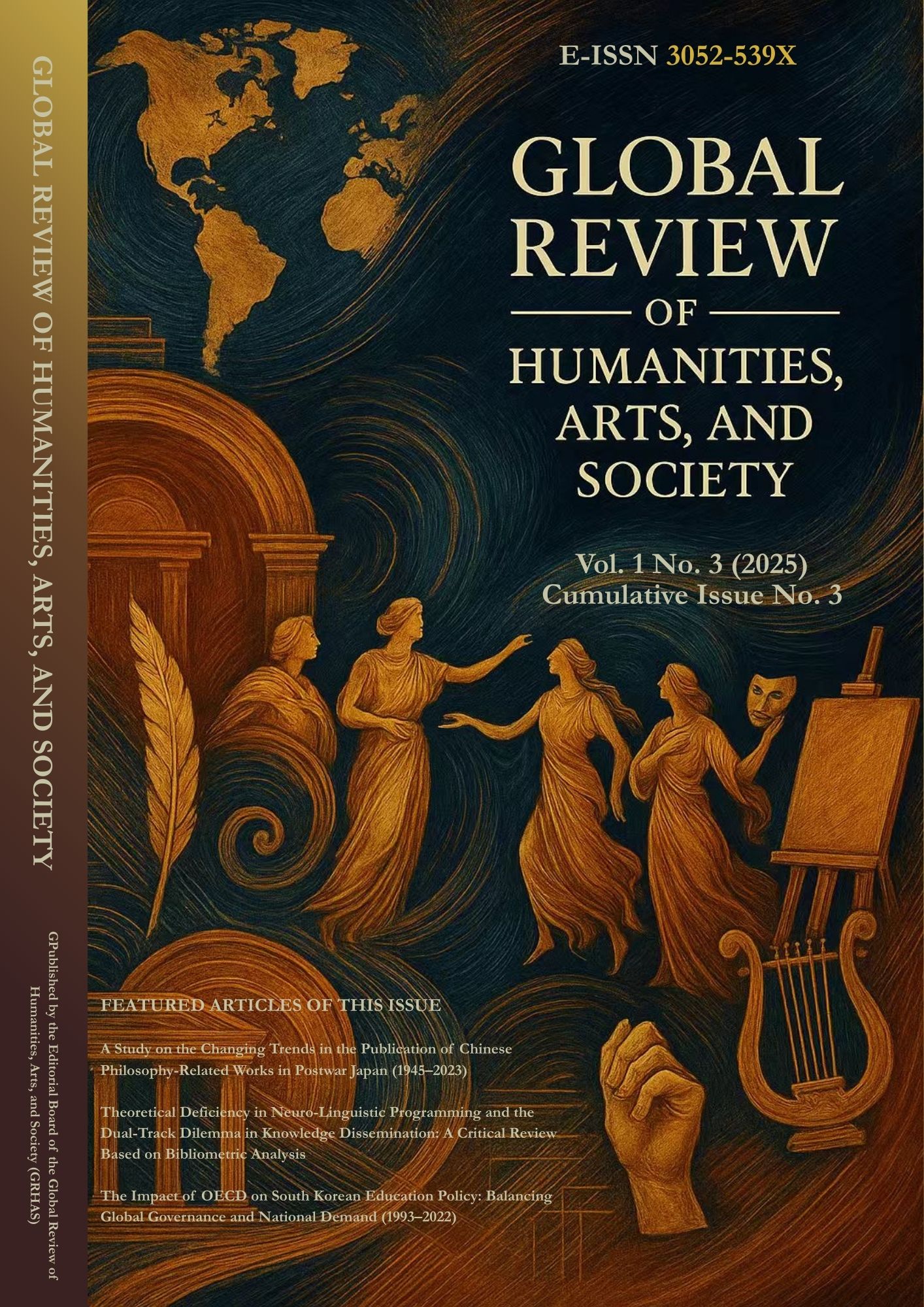
The August 2025 issue of Global Review of Humanities, Arts, and Society (GRHAS) presents seven original and theoretical articles that engage with pressing cultural, institutional, and epistemic transformations across East Asia. Contributors based in China and Malaysia offer grounded yet globally informed perspectives on topics ranging from international governance to philosophical historiography, and from educational reform to literary resistance.
Featured works investigate the role of the OECD in shaping South Korea’s education policies, statistical modeling of China’s rice trade dynamics, and the publishing trajectories of Chinese philosophy texts in postwar Japan. Other articles address critical gaps in the theory of Neuro-Linguistic Programming, propose age-sensitive frameworks for school-based crime prevention education, and examine shifting marriage values among Chinese youth under the influence of individualism. A final contribution explores subjection and gendered agency through a close reading of Lena Grove in Faulkner’s Light in August.
Together, these works embody GRHAS’s commitment to publishing scholarship that is theoretically robust, socially relevant, and transregionally engaged.
Published:
2025-08-05
Original Articles
-
An Analysis of Content Design and Age Appropriateness in Crime Prevention Education for Secondary Schools
Abstract: This study investigates the design and age appropriateness of crime prevention education in Chinese secondary schools, emphasizing the alignment between legal content and adolescent cognitive development. Drawing on interdisciplinary theories from education, developmental psychology, and criminal law, the paper analyzes existing curricular limitations, including excessive or vague content, lack of real-life relevance, and insufficient differentiation by age group. Comparative insights from the United States, Germany, and Japan highlight effective strategies such as spiral curriculum... [Read More] -
Components Identification in Finite Mixture Model
Abstract: Finite Mixture Model (FMM) are widely utilized in statistical analysis to model unobserved heterogeneity within complex datasets. A key challenge in their implementation is selecting the optimal number of components, as this directly affects the model’s interpretability, stability, and forecasting power. This study focuses on component selection strategies in FMMs, with particular emphasis on two widely used information criteria: the Akaike Information Criterion (AIC) and the Bayesian Information Criterion (BIC). While AIC favors model flexibility, BIC emphasizes parsimony and often... [Read More] -
A Study on the Changing Trends in the Publication of Chinese Philosophy-Related Works in Postwar Japan (1945–2023)
Abstract: In today's world, the state of a country's publishing industry can, to a certain extent, reflect its conditions across various sectors, including economy and culture. Chinese philosophical thought has long served as one of the foundational elements of Japanese culture. In early and premodern history, Japanese Confucianism and Kokugaku—both constructed on the basis of Chinese philosophy—formed the basis for understanding modern Japanese national character. The exchange of ideas in the universal and profound field of philosophy reflects not only the intellectual dialogue among academic... [Read More]
Theoretical Explorations
-
Resisting Normativity in Subjection:An Analysis of Lena Grove’s Vagrancy in Light in August
Abstract: of Light in August . However, the specific narrative strategies Faulkner employs to construct this luminous image need further critical examination. This study utilizes Judith Butler’s notion of normativity and subjection to elucidate Lena’s vagrancy, positioning it in relation to the novel’s titular “light”, the problems of the American South, and the broader condition of modernity: In her vagrancy, Lena not only adopts a resisting standpoint to the traditional identity of the Southern lady and the interpellation of Southern normativity, but also demonstrates a capacity to seek the... [Read More] -
The Influence of Individualism on Youth's View of Marriage in China
Abstract: With the advancement of social modernization, individualism—a value system that emphasizes personal autonomy, self-realization, and individual rights—has increasingly influenced the marriage concepts of the younger generation in China. The traditional marriage model, which centered on the family and collective responsibility, has gradually been replaced by a new conception of marriage that gives precedence to emotional fulfillment, personal compatibility, and equitable reciprocity. Individualism has prompted young people to place greater emphasis on self-actualization in their choice of a... [Read More] -
Theoretical Deficiency in Neuro-Linguistic Programming and the Dual-Track Dilemma in Knowledge Dissemination: A Critical Review Based on Bibliometric Analysis
Abstract: Neuro-Linguistic Programming (NLP), as a theoretical and practical framework widely applied in psychology, education, and business management, has garnered increasing attention from researchers in recent years. However, despite its notable application achievements, the foundational theoretical construction—particularly regarding the “logical levels of thinking”—remains relatively weak. This paper conducts a systematic analysis of Chinese and English literature related to NLP and “Neuro-Linguistic Programming” from 2000 to 2024, sourced from the Web of Science Core Collection and CNKI... [Read More]
Case Studies
-
The Impact of OECD on South Korean Education Policy: Balancing Global Governance and National Demand (1993-2022)
Abstract: This study focuses on the thirty-year period from 1993 to 2022, and analyses the impact of the Organisation for Economic Cooperation and Development (OECD) on South Korean education policymaking process in the context of global governance. At the same time, the study looks into the context of globalisation and explores the unique value and significance of South Korean education governance in this context. The results of the study show that the external influence of global governance is not a "foreign factor" that contradicts a country's own development needs. On the contrary, as long as... [Read More]