Vol. 1 No. 2 (2025): Imagining Structures, Negotiating Transitions: Body, State, and Meaning in a Shifting World
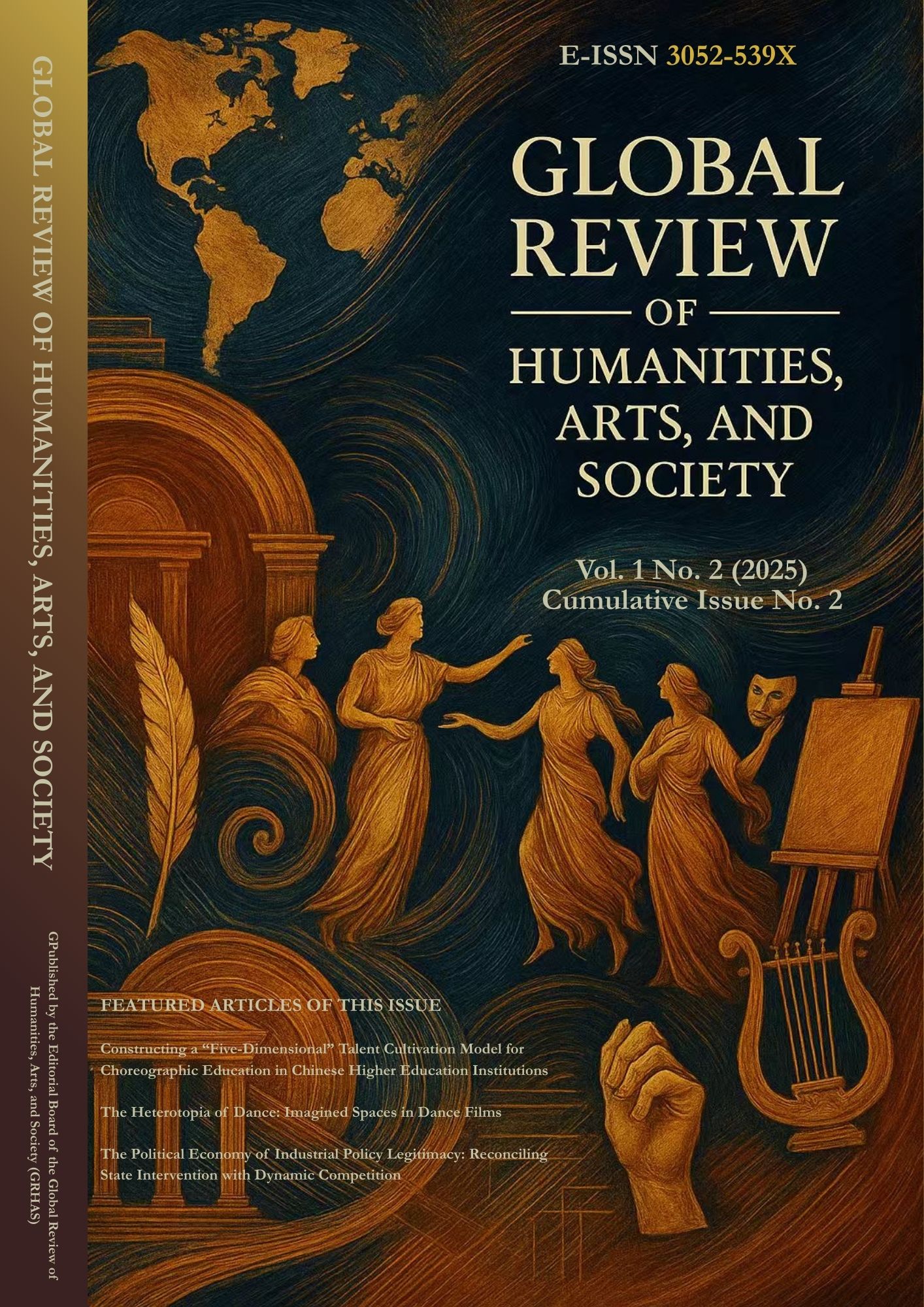
This issue of the Global Review of Humanities, Arts, and Society brings together cross-regional and cross-disciplinary insights into how individuals and institutions respond to cultural, emotional, and political flux. It features conceptual exploration of industrial policy legitimacy and dynamic state-market relationships; heterotopian space in dance cinema; and the symbolic reconstruction of authoritarian regimes in post-revolution Tunisia. Alongside these are human-centered inquiries into play-based parenting, tarot as urban self-reflection, and the spiritual revival among Asian youth. Across sectors—from public governance to private imagination—our contributors shed light on how new forms of order, resistance, and meaning are imagined and lived.
Published:
2025-06-04
Theoretical Explorations
-
Presenting Presence: A Study on the Application of Pina Bausch’s Question-Based Choreographic Method in Dance Creation
Abstract: As a seminal figure in Tanztheater (dance theatre), Pina Bausch brought about a fundamental shift in choreographic thinking—from the reproduction of movement to the presentation of presence. This paper examines her “question-based choreographic method” as an entry point to explore the philosophical underpinnings and artistic practices behind her creative approach. By analyzing the structural language and bodily expressions in Bausch’s representative works, the study traces how she grounded choreography in the personal experiences of dancers, using questions to provoke embodied responses.... [Read More] -
Study on Dance Communication Pathways: An Analysis Based on a Decentralized Communication Ecology
Abstract: With the advancement of digital media technologies and the rise of social platforms, dance dissemination is undergoing a significant shift from centralized to decentralized models. This study, adopting a decentralized communication ecology perspective, examines the changing dynamics of dance dissemination in terms of communication agents, media structures, and interaction mechanisms. Through case studies on platforms such as Douyin, Bilibili, and Xiaohongshu, the research identifies key trends including diversified agents, nonlinear dissemination pathways, and frequent audience... [Read More] -
Who Pays for Dance? — Choreographic Reflections on Audience Empathy and Work Interactivity
Abstract: While contemporary dance creation continues to innovate in visual form and technical expression, the question of whether audiences are truly engaged—whether they "buy in"—has become increasingly prominent. This paper explores how dance works can establish meaningful connections with audiences through mechanisms of empathy and interactivity. Focusing on sensory stimulation, emotional projection, and the co-construction of meaning, the study examines how choreographic strategies such as spatial design, intentional ambiguity in movement, and immersive staging contribute to audience resonance... [Read More] -
The Political Economy of Industrial Policy Legitimacy: Reconciling State Intervention with Dynamic Competition
Abstract: In recent years, both the EU and the US have revived industrial policy amid challenges like digital dominance, the green transition, and shifting geopolitical dynamics. This paper uses a comparative historical approach to examine the legitimacy of industrial policy across post-WWII development, Cold War tech strategies, globalization, and current initiatives like the CHIPS Act, the EU Green Deal, and the Inflation Reduction Act. The study finds a move from static to Schumpeterian competition models, reframing legitimacy debates. While concerns about rent-seeking persist, proponents... [Read More] -
The Heterotopia of Dance: Imagined Spaces in Dance Films
Abstract: Dance films, as a cinematic genre that integrates bodily art with narrative expression, profoundly reflect the tension between social power, bodily discipline, and the expression of freedom through the dynamic construction of space. This study aims to explore the characteristics and narrative functions of heterotopian spaces in dance films, revealing their representation and significance in the relationship between power and freedom. Adopting a qualitative analytical approach, the study uses Foucault’s theory of “heterotopia” as its central framework and examines three classic dance... [Read More]
Case Studies
-
Nostalgia for the Strong State: Representations of the Former Regime in the Tunisian Social Imagination in Times of Crisis
Abstract: More than a decade after the Tunisian revolution, amid deepening crises and disillusionment with democracy, a significant social phenomenon has emerged: nostalgia for a “strong state.” This sentiment does not reflect an objective reassessment of the authoritarian past, but rather a symbolic and emotional reconstruction shaped by present-day failures. As the state’s ability to ensure stability and dignity declines, many citizens increasingly view the former regime not as a dictatorship, but as an efficient and orderly authority. Based on 30 in-depth interviews, this study examines how the... [Read More]
Book Reviews
-
The Wisdom of Parenting with Love and Freedom: A Review of A Good Mom Is Better Than a Good Teacher
Abstract: A Good Mom Is Better Than a Good Teacher by Yin Jianli advocates a parenting philosophy grounded in love, freedom, and respect for children’s individuality. Through real-life cases, the author challenges traditional authoritarian methods, proposing that autonomy, emotional empathy, and interest-driven learning are far more effective than control and pressure. The book encourages parents to step back, reduce intervention, and adopt a mindset of trust, humor, and long-term vision. While the book’s examples draw heavily from Yin’s personal experiences—raising concerns about... [Read More] -
Healing in Laughter: When Play Becomes the Secret Language of Parent-Child Relationships
Abstract: Abstract : Playful Parenting by Dr. Lawrence J. Cohen reveals the transformative power of play in parent-child relationships. Challenging traditional, instruction-focused parenting methods, the book emphasizes that laughter and playful interaction are essential tools for emotional bonding, communication, and conflict resolution. Cohen illustrates how children naturally use play to process emotions, reduce anxiety, and build confidence, while adults often overlook its significance. Through practical examples and a rich “play toolbox,” he demonstrates how even difficult moments—like... [Read More]
Original Articles
-
Constructing a “Five-Dimensional” Talent Cultivation Model for Choreographic Education in Chinese Higher Education Institutions
Abstract: This study addresses the current challenges and reform needs in the cultivation of choreographic talent within Chinese higher education institutions. It proposes a structured Five-Dimensional Competency Model, encompassing: (1) artistic aesthetics and cultural literacy, (2) choreographic thinking and methodological competence, (3) physical expression and movement development, (4) technological integration and media literacy, and (5) practical skills and project execution. Through an in-depth analysis of prevalent issues—such as limited curricular scope, insufficient integration of... [Read More]
Perspectives & Commentaries
-
The Mirror, Not the Crystal Ball: A Psychological Analysis of Tarot as a Self-Reflection Tool
Abstract: This essay examines the contemporary evolution of tarot practice from divinatory tool to psychological instrument for self-reflection. While traditionally associated with fortune-telling, tarot has gained increasing popularity in modern urban centers like Hong Kong and London as a structured framework for introspection and personal growth. Using psychological theories of projection, archetypal symbolism, and narrative therapy, it argues that tarot’s symbolic language facilitates psychological benefits such as improved self-awareness, emotional clarity, and meaning making . Its... [Read More] -
Post-Pandemic Religious Revival in Asia: The Spiritual Quest of the Younger Generation and Its Social Impact
Abstract: This essay explores the post-pandemic religious revival among Asian youth, particularly focusing on Japan and Thailand, where traditional religious practices have experienced renewed interest. Following the social isolation and existential questioning triggered by COVID-19, young Asians aged 18-35 have shown increased engagement with Shinto shrines in Japan and Buddhist meditation retreats in Thailand. This phenomenon is more than a mere reaction to crisis ; it is a deeper spiritual quest for significance, community, and identity in societies which have undergone such rapid... [Read More]