Vol. 1 No. 1 (2025): Navigating Governance, Expression, and Identity in the Digital Age
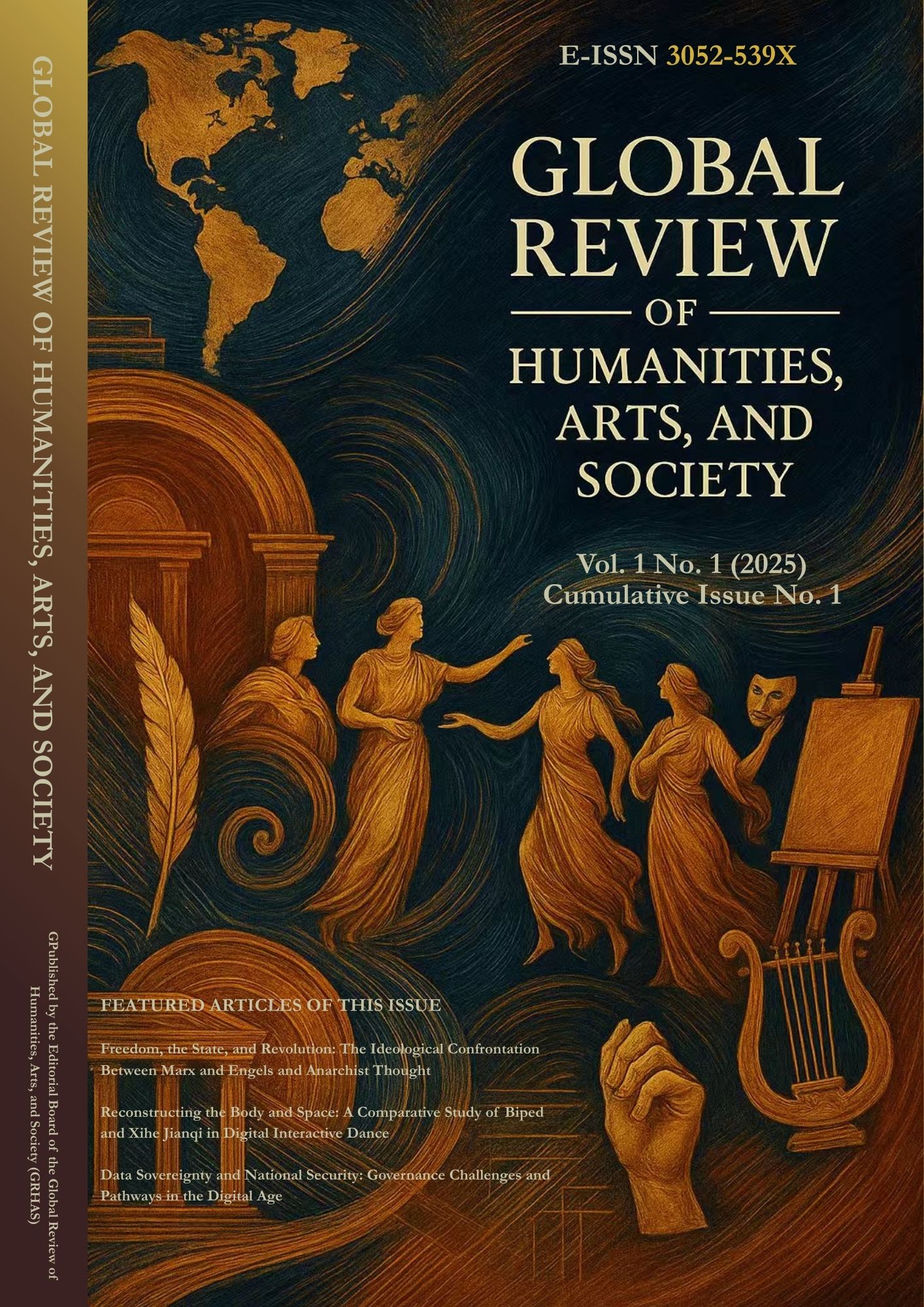
This thematic issue of Global Review of Humanities, Arts, and Society investigates the complex ways in which digital technologies intersect with governance systems, cultural expression, and identity formation in the contemporary world. Spanning political studies, philosophy, regional development, and the arts, the articles in this volume offer a diverse range of perspectives—from case studies on cultural and tourism integration in Chongqing, public service motivation among female civil servants, and data sovereignty in the digital age, to theoretical reflections on Marxist and anarchist ideologies, and the philosophical foundations of consciousness and reality. The issue also features creative interpretations of classical aesthetics, such as Plato’s theory of art as embodied in contemporary dance works exploring alienation and selfhood. Together, these contributions highlight how digital transformation mediates institutional systems and individual creativity, offering an interdisciplinary dialogue on the shifting realities of power, meaning, and self in the digital age.
Published:
2025-04-03
Theoretical Explorations
-
Consciousness and Reality: A Comparative Study of the Philosophical Foundationsof Marx and Hegel
Abstract: This study offers a comparative analysis of the philosophical foundations of G. W. F. Hegel and Karl Marx with a focus on their respective conceptions of consciousness and reality. Drawing from classical texts and contemporary scholarship, it reconstructs Hegel’s dialectical idealism, which views reality as the unfolding of Absolute Spirit, and contrasts it with Marx’s materialist dialectics, which locates consciousness in socio-historical praxis. The analysis highlights Marx’s critique of Feuerbach’s abstract humanism and Stirner’s radical egoism, culminating in the notion of the “real... [Read More] -
Freedom, the State, and Revolution:The Ideological Confrontation Between Marx and Engels and Anarchist Thought
Abstract: In the 19th century, as socialist movements proliferated across Europe, anarchism emerged as both a theoretical and political adversary to Marxism. This paper critically examines the ideological divergences between Marx and Engels and two key figures in anarchist thought—Max Stirner and Mikhail Bakunin. Stirner’s egoist anarchism, rooted in philosophical idealism, is analyzed and contrasted with Marx's materialist conception of the individual and freedom. Bakunin’s political anarchism, which advocated the immediate abolition of the state, is likewise critiqued through the lens of... [Read More]
Original Articles
-
Cultural and Tourism Integration in Chongqing City: Digital Economy and High-Quality Growth
Abstract: The synergy between culture and tourism is crucial in driving urban digital traffic and fostering economic vitality. Within the framework of the digital economy, their symbiotic relationship is further amplified by digital technology, which catalyzes high-quality development. Digital advancements are reshaping these sectors by optimizing production processes, refining market segmentation, and innovating revenue distribution mechanisms. Furthermore, digital tools enable real-time monitoring of market dynamics, improving efficiency and adaptability while fostering strategic decision-making... [Read More] -
Brand Communication Innovation in the New Media Environment: Consumer Trust, Social Media Interaction, and Psychological Resonance
Abstract: As digital platforms redefine brand-consumer relationships, social media has emerged as a vital channel for fostering consumer trust, emotional engagement, and innovation acceptance. This study examines how brands leverage user-generated content (UGC), influencer marketing, and Metaverse experiences to shape consumer perception and behavior. Drawing on ten in-depth case studies from the Global Breakthrough Innovation White Paper (2024), the research employs a qualitative, multi-case approach to analyze how these strategies activate trust and identity through digital interaction. The... [Read More] -
Data Sovereignty and National Security: Governance Challenges and Pathways in the Digital Age
Abstract: In the digital age, data has become an integral part of national security, and the issue of data sovereignty is increasingly becoming a global focus. The intensification of global data flow and the rapid development of information technology present numerous challenges for countries in protecting their data, ensuring national security, and safeguarding economic interests. The maintenance of data sovereignty has become a part of international geopolitical competition. In response to these challenges, countries must strengthen their data governance frameworks, establish stringent data... [Read More] -
Explaining Public Service Motivation among Female Civil Servants: The Role of Organizational Culture and Leadership in South Korea
Abstract: This study explores the impact of organizational culture (OC), perceived leadership (PL), and work-life balance (WLB) on public service motivation (PSM) among female civil servants in South Korea. Utilizing data from the 2023 Korean Civil Service Survey (N = 3,196), hierarchical multiple regression was conducted to assess the direct effects of OC and PL, and the potential moderating role of WLB. The results show that both OC and PL have strong and significant positive effects on PSM, confirming their roles as key organizational drivers of motivation. While the proposed moderating effects... [Read More] -
The Influence of Political Interest and Participation on Satisfaction with Authorit arian Regimes: A Comparative Analysis of Russia and Kazakhstan
Abstract: This study explores the relationship between political interest, political participation, and regime satisfaction in two post-Soviet authoritarian countries: Russia and Kazakhstan. Drawing on data from the 2018 World Values Survey, the analysis categorizes political participation into institutional, non-institutional, and internet-based forms. Using OLS regression models, the study finds that institutional participation, particularly voting, is positively and significantly associated with regime satisfaction in both countries. Non-institutional forms of participation, such as protests,... [Read More]
Book Reviews
-
Between Communication Ethics and the Common Good: A Review of Son Young Jun’s Political Philosophy from a Republicanism Perspective
Abstract: Son Young Jun’s Political Philosophy is a systematic inquiry into key issues in political thought, with a particularly insightful treatment of Republicanism. As a scholar in communication studies, I found the book not only theoretically illuminating but also deeply relevant to the interdisciplinary dialogue between political philosophy, media ethics, and governance. This review draws on Son’s Republicanism framework to explore its applicability in today’s media environment and further reflects on its relevance to geopolitical challenges and the practice of socialism with Chinese... [Read More]
Art Practices & Reflections
-
Reconstructing the Body and Space: A Comparative Study of Biped and Xihe Jianqi in Digital Interactive Dance
Abstract: This study explores how digital technology reshapes the aesthetics of dance performance by analyzing two representative works: Biped (1999) by Merce Cunningham and Xihe Jianqi (2020) produced by the China Dancers Association. Through a comparative framework, the research investigates the interaction between body, technology, space, narrative, and audience experience within digital interactive dance. While Biped utilizes motion capture and computer graphics to abstract and depersonalize the body in a non-narrative structure, Xihe Jianqi integrates... [Read More] -
Dance Creation Based on Plato’s Theory of Art: A Study of Alienation — Who Is Living My Life?
Abstract: This study explores the application of Plato’s theory of art in the context of dance creation, with a focus on the dance film Alienation – Who Is Living My Life? as a case study. According to Plato, art is a form of “mimesis” — an imitation of reality — that should uphold moral guidance while maintaining rationality and order. Grounded in this theoretical framework, the research investigates the significance and value manifested through the dancer’s body as a medium in the reconstruction of reality via dance on screen. The choreography centers on the theme of the modern workplace,... [Read More]