Vol. 1 No. 4 (2025): Cultural Interfaces in Perception, Memory, and Governance
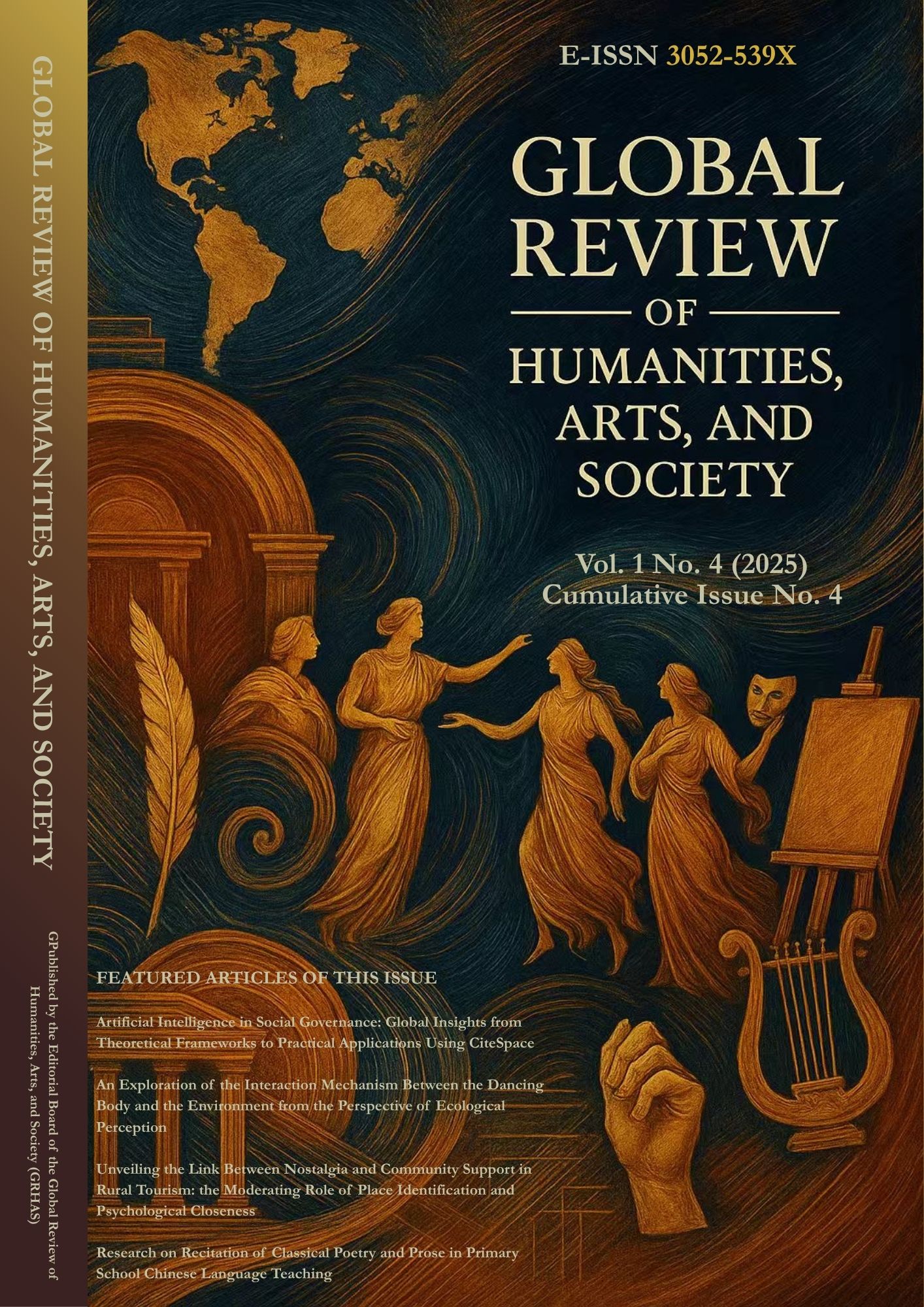
Global Review of Humanities, Arts and Society (GRHAS), Volume 1, Issue 4 (2025), presents a collection of original research and theoretical investigations under the theme “Cultural Interfaces in Perception, Memory, and Governance.”
This issue features four peer-reviewed articles that explore interdisciplinary approaches to affect, education, embodiment, and digital governance:
-
Affective belonging and community engagement: Examines how nostalgia psychologically motivates community support behavior in rural tourism contexts.
-
Cultural transmission through education: Investigates the pedagogical and cognitive value of classical poetry recitation in primary school Chinese language teaching.
-
Embodied perception in choreographic practice: Applies ecological perception theory to understand dancer–environment interaction in site-specific dance.
-
Digital governance and AI ethics: Offers a bibliometric and comparative study of global trends in AI-enabled social governance using CiteSpace analysis.
Together, these contributions articulate how emotion, body, technology, and cultural identity intersect within contemporary societal frameworks, advancing cross-disciplinary dialogue across the humanities, arts, and social sciences.
Published:
2025-10-03
Original Articles
-
Unveiling the Link Between Nostalgia and Community Support in Rural Tourism: the Moderating Role of Place Identification and Psychological Closeness
Abstract: Grounded in Conservation of Resources (COR) theory, this study explores the psychological mechanisms driving community support behavior (CSB) in rural tourism. Drawing on data from 637 rural tourists, it applies Partial Least Squares Structural Equation Modeling (PLS-SEM), Necessary Condition Analysis (NCA), and machine learning techniques including Support Vector Machine (SVM) classification and heatmap visualization. The findings reveal that nostalgia indirectly influences CSB through intergenerational responsibility, with psychological closeness and place identity serving as... [Read More] -
Artificial Intelligence in Social Governance: Global Insights from Theoretical Frameworks to Practical Applications Using CiteSpace
Abstract: This study presents a comprehensive examination of the evolving role of artificial intelligence (AI) in social governance through an integrated bibliometric, theoretical, and case-based methodology. Utilizing CiteSpace-based keyword co-occurrence and burst analyses of data from 2014 to 2024, it identifies ten thematic clusters that illustrate a dual developmental trajectory: a vertical deepening of governance theories and technological paradigms, and a horizontal expansion into domains such as smart cities, environmental governance, and algorithmic administration. A critical review of... [Read More]
Theoretical Explorations
-
Research on Recitation of Classical Poetry and Prose in Primary School Chinese Language Teaching
Abstract: Ancient poetry serves as a vital vessel of historical and cultural traditions. Engaging students in the recitation of classical poetry not only fosters their curiosity and appreciation for literary heritage but also strengthens self-directed learning and language competence, aligning with the goals of contemporary quality-oriented education. Nevertheless, current teaching practices reveal several pressing challenges. This study examines the context of Chinese language instruction in primary schools, explores practical approaches to integrating classical poetry recitation, and offers... [Read More] -
An Exploration of the Interaction Mechanism Between the Dancing Body and the Environment from the Perspective of Ecological Perception
Abstract: This study employs ecological perception theory to examine its application and significance in dance improvisation and choreography. The theory emphasizes the direct coupling of perception and action, whereby movement emerges dynamically through the dancer–environment interaction. Three dimensions are highlighted: affordances, referring to how dancers perceive physical and spatial properties as potential movement possibilities; the perception–action loop, underscoring the ongoing refinement and extension of movement through embodied experience; and body–environment coupling, which... [Read More]