Vol. 2 No. 1 (2026): Digital Transformations, Cultural Dynamics, and Critical Perspectives in Contemporary Society
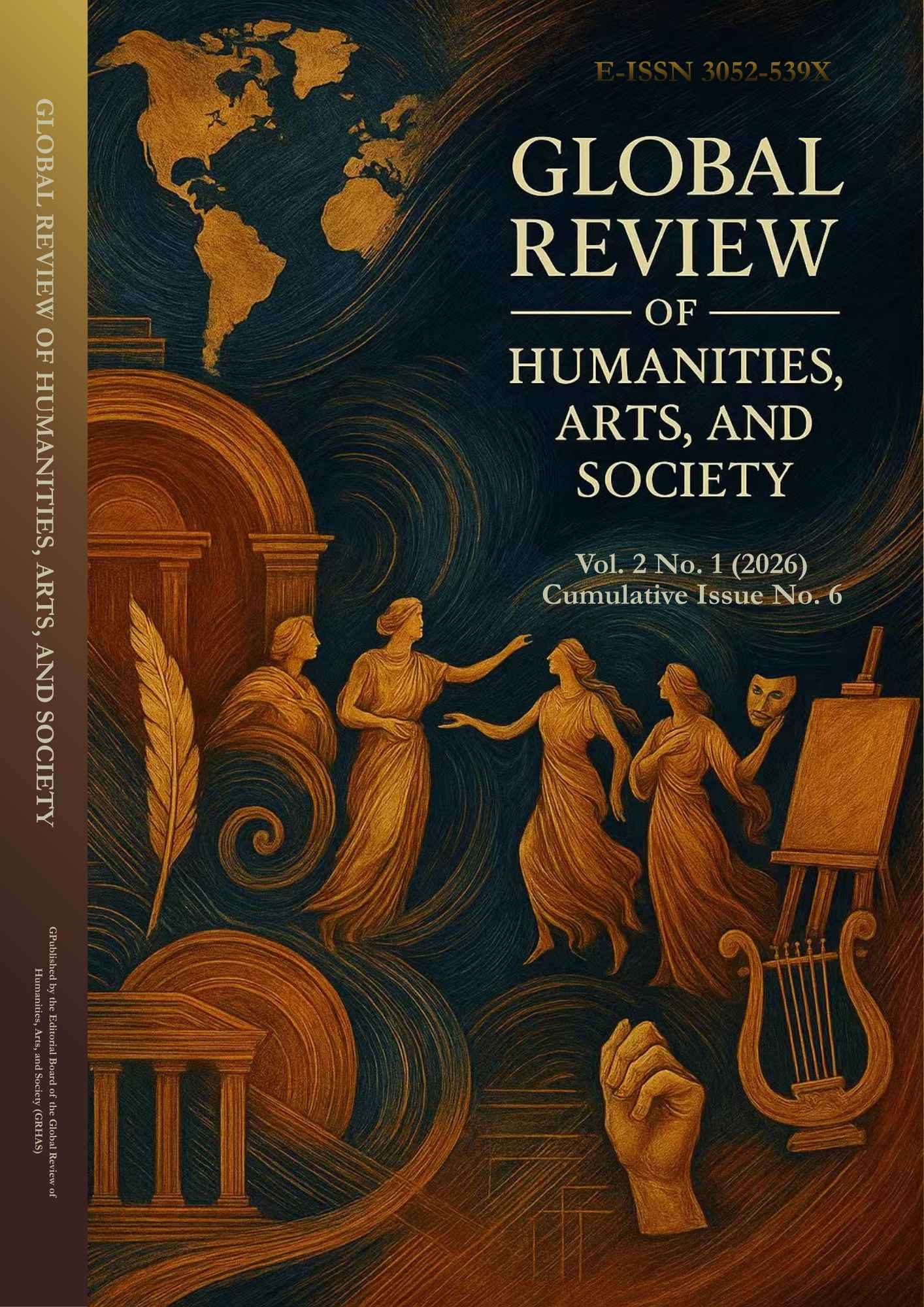
Global Review of Humanities, Arts, and Society (GRHAS), Volume 2, Issue 1 (2026), presents a collection of interdisciplinary contributions addressing key issues in contemporary humanities, arts, and social sciences.
This issue explores themes such as digital transformation, migration, cultural production, and data governance through theoretical analyses, empirical case studies, and critical reviews. It highlights emerging debates on technology, visibility, and social justice, while foregrounding decolonial and context-sensitive approaches.
Together, these contributions reflect GRHAS’s commitment to advancing critical, globally engaged scholarship across disciplines.
Published:
2026-02-16
Theoretical Explorations
-
Understanding the Digital Transformation of SMEs: A Systematic Review from a Dynamic Capabilities Perspective Across Business, Technology, and Societal Domains
Abstract: The impact of digital technologies on various industries has been transformative, restructuring and disrupting existing business and operational models. Small and medium-sized enterprises (SMEs) are vital to the economies of countries worldwide, leading to increased interest in their Digital Transformation (DT) from both industry and academia. However, these disruptive changes extend beyond individual companies; they also have environmental and societal implications. Over the past two decades, research on the Digital Transformation of SMEs (SMEs' DT) has garnered significant attention,... [Read More]
Case Studies
-
From Resource Endowment to Innovation-Driven Development: A Quantitative Analysis of the Integration Dynamics in Regional Cultural Tourism
Abstract: This study addresses the critical transition of regional cultural tourism from traditional resource-dependency to an innovation-driven paradigm. Grounded in Dynamic Capabilities Theory, we develop a quantitative AHP-FCE framework to evaluate this structural shift. Using Shandong Province as an empirical case, the assessment yields a “Good” integration score (0.764), predominantly driven by static heritage endowments and economic scale. However, a critical “resource-innovation gap” emerges: technological innovation, despite being the most heavily weighted dynamic driver, significantly lags... [Read More]
Book Reviews
-
Studying Migration through Visibility? Method, Invisibility, and the Politics of Digital Migration Research A Review of Doing Digital Migration Studies: Theories and Practices of the Everyday
Abstract: This critical book review examines Doing Digital Migration Studies: Theories and Practices of the Everyday (Leurs & Ponzanesi, eds., 2024), a landmark edited volume that explores how migration is increasingly mediated, studied, and governed through digital technologies. The review contends that the book makes a significant contribution by reframing digital media not as neutral research tools but as ontological conditions that shape migrant experiences, while simultaneously emphasizing everyday practices and methodological reflexivity. Drawing on a diverse range of empirical... [Read More] -
Functionalizing Intimacy? Technological Mediation and the Limits of Emotional Optimization A Review of Relationships 5.0: How AI, VR, and Robots Will Reshape Our Emotional Lives
Abstract: This critical book review examines Elyakim Kislev’s Relationships 5.0: How AI, VR, and Robots Will Reshape Our Emotional Lives (2022), which argues that emerging technologies are transforming intimate relationships from human-centered bonds into modular, technologically mediated connections. Drawing on a historical-sociological framework, Kislev proposes a periodization of relational forms culminating in “Relationships 5.0,” where artificial intelligence, virtual reality, and robotics function not merely as communication tools but as active relational partners capable of fulfilling... [Read More] -
From Inflammation to Liberation: Reading Inflamed as a Decolonial Medical Manifesto
Abstract: This review critically examines Inflamed: Deep Medicine and the Anatomy of Injustice by Rupa Marya and Raj Patel, positioning it as a significant contribution to decolonial medical thought. The book argues that chronic inflammation should be understood not only as a biological process but also as a somatic response to systemic injustice—including colonialism, racial capitalism, and ecological destruction. Through narrative case studies and theoretical analysis, the authors develop the concept of "political anatomy" to reveal how bodily systems reflect broader social and environmental... [Read More]
Perspectives & Commentaries
-
When Data Justice Becomes Governance: On the Depoliticization of a Critical Concept
Abstract: This commentary critically examines the contemporary trajectory of as a central concept in critical data studies, focusing on how its political impact risks being diluted as it is incorporated into governance-oriented frameworks. Revisiting the agenda-setting article Data Justice by Lina Dencik and Javier Sánchez-Monedero (2022), the commentary positions data justice not as a fixed normative standard but as an open and contested political framework rooted in critiques of surveillance, datafication, and structural inequality. While Dencik and Sánchez-Monedero emphasize the instability... [Read More]