Vol. 2 No. 1 (2026): Volume 2, Number 1, June 2026
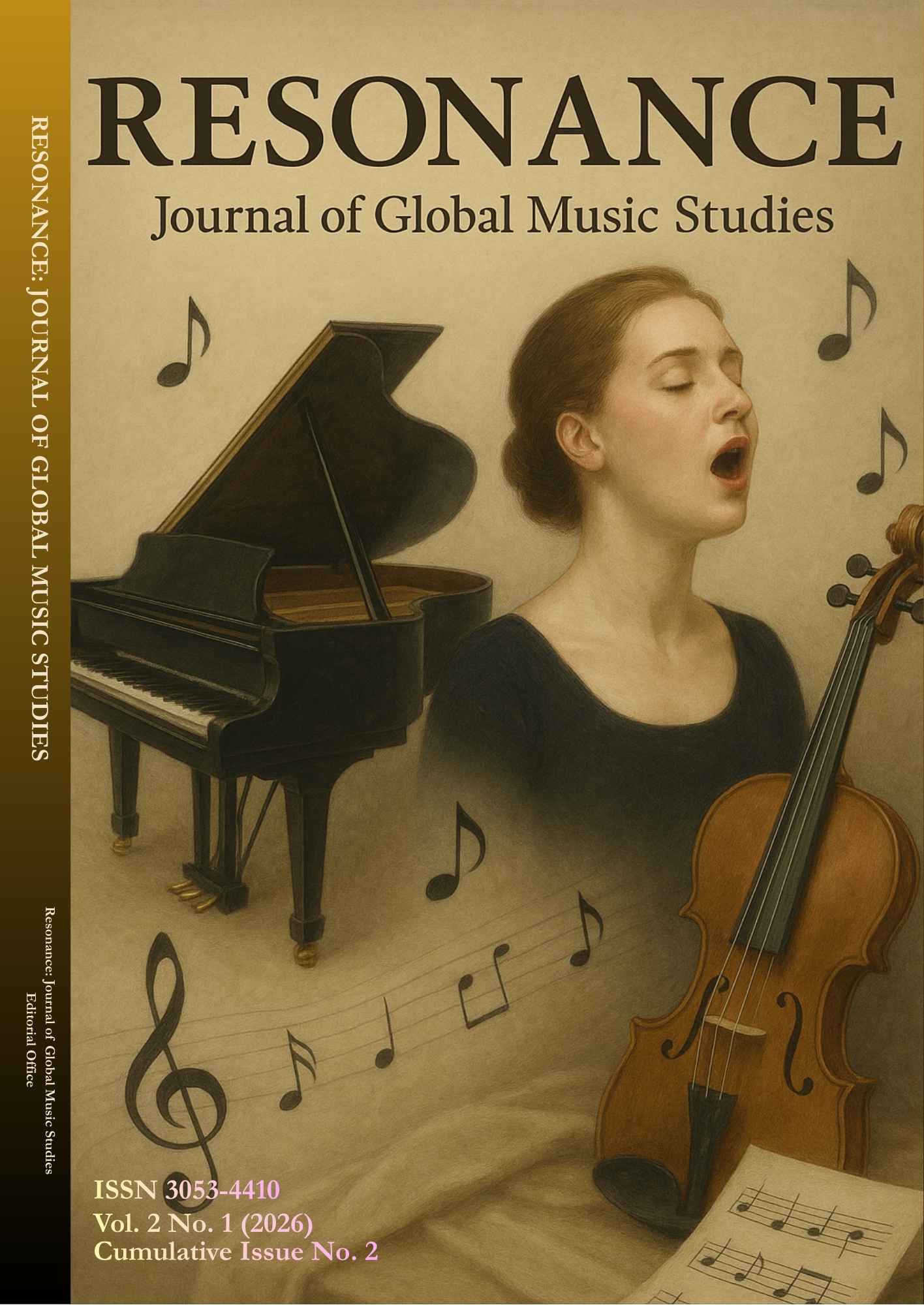
This issue (Volume 2, Number 1, June 2026) of Resonance: Journal of Global Music Studies presents peer-reviewed research articles and scholarly contributions exploring cross-cultural, transhistorical, and interdisciplinary approaches to music studies.
The journal publishes original research in musicology, ethnomusicology, and related fields, fostering global academic dialogue across languages and traditions.
Published:
2026-06-01
Voices Now: Contemporary Soundscapes
-
The Breakthrough of Impressionist Music in Traditional Functional Harmony and Its Enlightenment for Contemporary Music — 印象主义音乐对传统功能和声的突破与当代音乐的启示
Abstract: Impressionist music emerged at the turn of the twentieth century as a significant reorientation of traditional functional harmony. Rather than prioritizing tonal stability and structural teleology, Impressionist composers foregrounded harmonic color, timbre, and atmospheric resonance as primary expressive elements. Drawing on existing scholarship on Impressionist harmony, this article examines how the use of whole-tone scales, pentatonic materials, blurred cadences, and pedal techniques reshaped conventional harmonic logic and rebalanced the relationship between function and sonority.... [Read More]
Performance Notes
-
The Formal Structure and Narrative Musical Language of Ambush on All Sides (Pipa Repertoire) — 琵琶大曲《十面埋伏》的曲式结构与叙事性音乐语言
Abstract: As one of the most iconic works in the Chinese pipa repertoire, Ambush on All Sides presents a vividly dramatic musical narrative based on the historical Battle of Gaixia between Chu and Han. Using formal structure as the analytical starting point, this study traces the work’s narrative trajectory—pre—war, mid—war, and post—war—through a close examination of pitch organization, rhythmic design, timbral contrast, and articulation patterns. Particular attention is given to the interaction between sectional design and performative layering, demonstrating how tempo, dynamics, instrumental... [Read More]