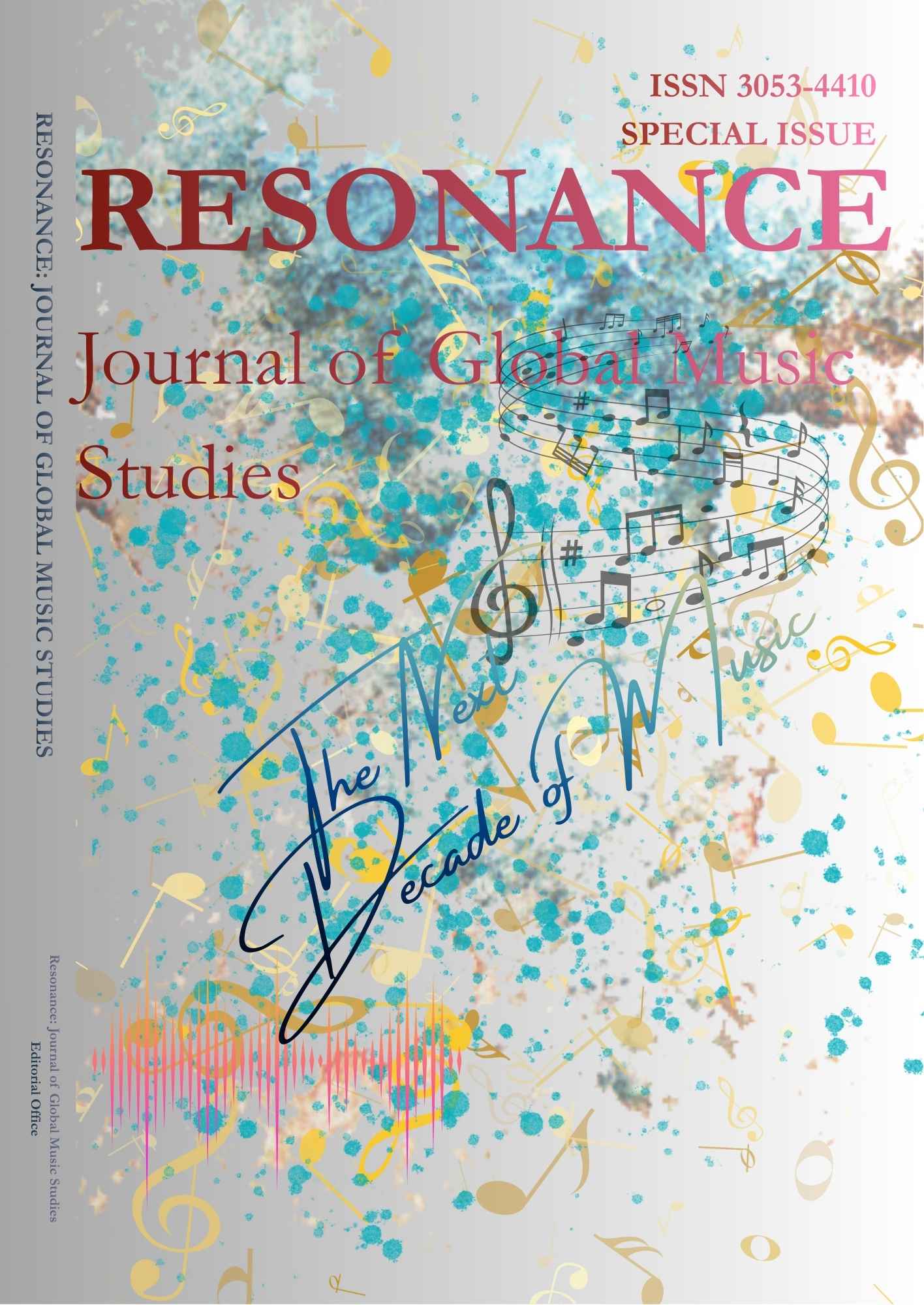
Abstracts of the Resonance Annual Conference 2026: The Next Decade of Music
 University of Malaya, Kuala Lumpur, Malaysia
中国传媒大学(Communication University of China, Beijing, China)
南京艺术学院(Nanjing University of the Arts, Nanjing, China)
Beijing Normal-Hong Kong Baptist University, Zhuhai, China
Renmin University of China, Beijing, China
独立学者(Independent Scholar, China)
南京艺术学院(Nanjing University of the Arts, Nanjing, China)
University of Malaya, Kuala Lumpur, Malaysia
中国传媒大学(Communication University of China, Beijing, China)
南京艺术学院(Nanjing University of the Arts, Nanjing, China)
Beijing Normal-Hong Kong Baptist University, Zhuhai, China
Renmin University of China, Beijing, China
独立学者(Independent Scholar, China)
南京艺术学院(Nanjing University of the Arts, Nanjing, China)
Abstract
This abstract collection records the conference abstracts and extended abstracts presented at the Resonance Annual Conference 2026, convened online under the theme “The Next Decade of Music.” The conference brought together researchers, educators, and independent scholars to examine how musical practices, analytical frameworks, and educational approaches are evolving in response to technological change and broader social and cultural transformations.
The collection reflects a diverse set of research concerns, including the use of artificial intelligence in audiovisual music creation, algorithmic aesthetics and global cultural circulation, contemporary popular music and identity formation, micro-sociological approaches to opera and performance, media-mediated listening and urban music consumption, and the changing social functions of higher music education. It also highlights questions of equity and access, including discussions of digitally enabled models for rural music education.
Published as part of a special issue of Resonance: Journal of Global Music Studies, the texts included here are conference abstracts or extended abstracts derived from oral presentations. They are intended to support scholarly exchange and to document current conversations and emerging directions in global music studies. The materials in this collection have not undergone full peer review and should not be interpreted as full-length research articles. Rather, they provide an accessible record of the conference programme and encourage the subsequent development of presentations into formal journal submissions.
Keywords:
conference abstracts; music studies; global music research; interdisciplinary music studies; academic exchange; Resonance Annual ConferenceData Availability Statement
No datasets were generated or analyzed for this conference abstract collection.
Copyright Notice & License:
All articles published in Resonance: Journal of Global Music Studies are licensed under the terms of the Creative Commons Attribution 4.0 International License (CC BY 4.0).
Under this license, authors retain the copyright of their work, while allowing others to:
-
Share – copy and redistribute the material in any medium or format
-
Adapt – remix, transform, and build upon the material for any purpose, even commercially
provided that appropriate credit is given to the original author(s), a link to the license is included, and any changes made are indicated.
There are no restrictions on reuse, provided the original source is cited properly. This open license maximizes the dissemination, accessibility, and impact of published research.
Summary of Rights:
-
Authors retain full copyright.
-
The journal holds the right of first publication.
-
Reuse, distribution, and commercial use are permitted under CC BY 4.0.
-
No embargo period applies.
The full legal code of the license is available at:
https://creativecommons.org/licenses/by/4.0/

This work is licensed under a Creative Commons Attribution 4.0 International License.