

Silence

Announcements

Editorial Announcement: Author Submission Requirements / 编辑公告:作者投稿与出版政策说明

2026-03-10

This journal builds upon the scholarly tradition associated with Silence (Springer Nature, ISSN: 1758-907X), which has now been archived, while developing its own research framework and editorial practices.

本刊在学术理念上承接 Springer Nature 出版期刊 Silence(ISSN: 1758-907X)的研究传统。该期刊目前已归档。本刊在此基础上发展自身的研究框架与编辑实践

Read more about Editorial Announcement: Author Submission Requirements / 编辑公告:作者投稿与出版政策说明
Current Issue

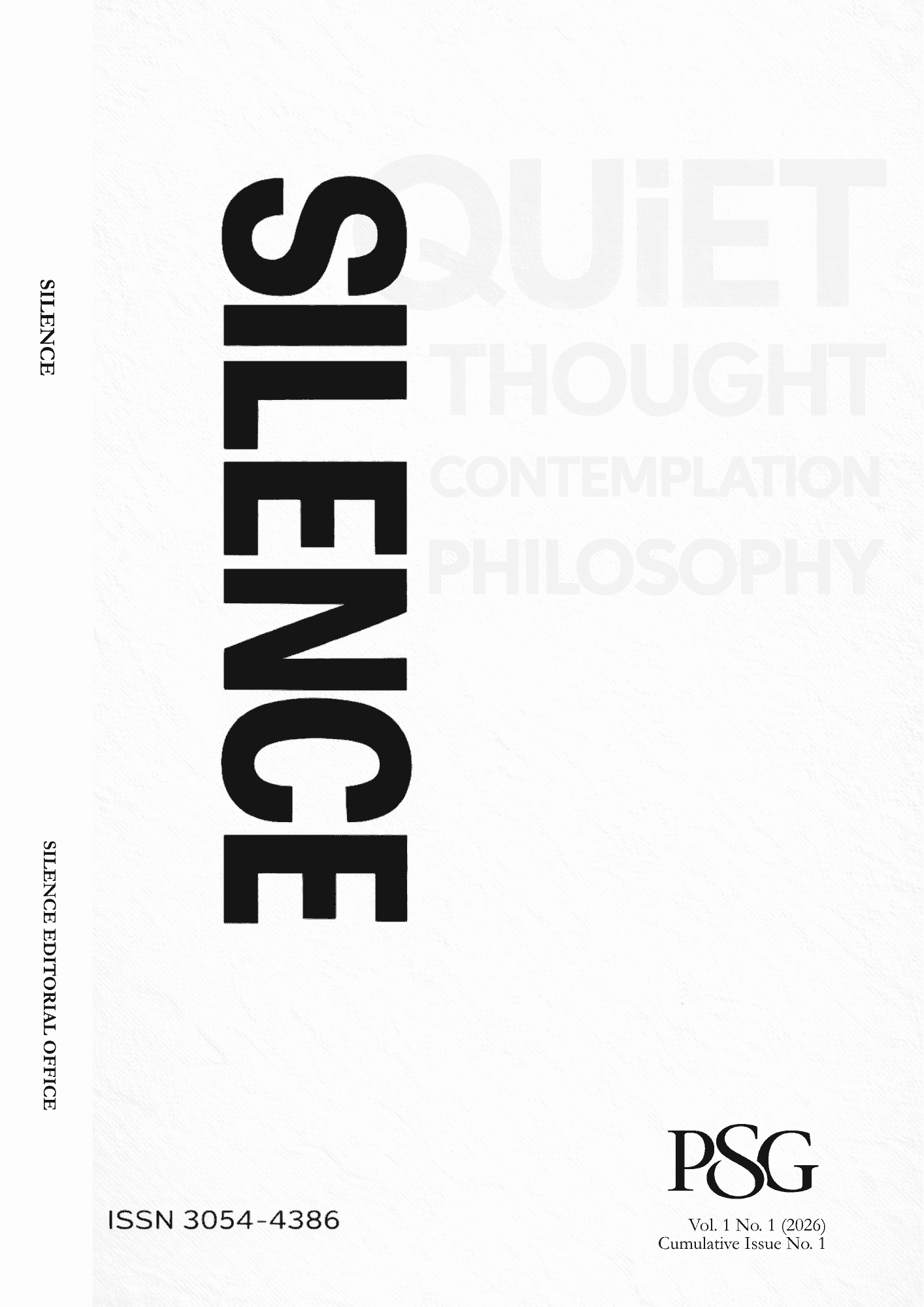
Vol. 1 No. 1 (2026): The beginning of the Silence
					View Vol. 1 No. 1 (2026): The beginning of the Silence

Do you have failed experiments, half-written article drafts you can't bring yourself to finish, shelved proposals, or papers that just won't get published no matter what? If so, you're welcome to submit them to Silence—let your "papers" break the silence once and for all!

Published: 2026-02-14

Quiet Research

  • Old-Age Security and Development of the Health and Wellness Economy: Empirical Test Based on the China Health and Retirement Longitudinal Study

    Michael Kong (Author)
    40-47
    Abstract: The health of the elderly population and the upgrading of the health and wellness industry are crucial and integral components of the national strategy for addressing population aging in the new era. Based on matched data from the 2018 China Health and Retirement Longitudinal Study (CHARLS), this paper analyzes the impact of pension receipt on the demand for the health and wellness industry. Employing causal analysis techniques with instrumental variables, the study finds that receiving a pension has a significant positive effect on the demand for hospital treatment and health checkups,... [Read More]
    DOI: https://doi.org/10.5281/zenodo.18706300
  • How Modern Academia Shapes Philosophical Questioning: Institutional Conditions, Logics of Publishability, andInstitutional Silence

    Huayang Song (Author)
    48-53
    Abstract: This article challenges the widely held assumption that philosophical questions arise spontaneously from thought itself. By situating contemporary philosophy within the institutional transformations of neoliberal higher education, it argues that inquiry is pre-structured by what is termed the logic of publishability. Through an analysis of evaluation metrics, grant-based project governance, and journal gatekeeping, the paper conceptualizes a “triple mechanism” that regulates not the answers philosophers produce, but the forms, tempos, and boundaries of the questions they are permitted to... [Read More]
    DOI: https://doi.org/10.63802/silence.V1.I1.251

Failed Experiments

  • SHIT: A Negative Adaptive Attention Model in Few Shot LearningCapability named APA

    Yaolin Zhang, Pengrong Huang (Author)
    3-12
    Abstract: We present Adaptive Prototype Attention (APA), a task-aware, prototype-guided, and multi-scale attention mechanism tailored for few-shot learning with Transformer-style architectures. APA (i) modulates attention weights with task context, (ii) injects prototype-conditioned signals to enhance within-class cohesion and between-class separation, and (iii) aggregates local and global dependencies across multiple scales. In controlled few-shot classification experiments (5-way, 5-shot, synthetic episodes), APA consistently underperforms strong baselines. Compared with standard attention, APA... [Read More]
    DOI: https://doi.org/10.5281/zenodo.18666933
  • A Componential Analysis of “Fuck”

    Eloise Gou (Author)
    54-61
    Abstract: This study examines how effective Componential Analysis (CA), a classic semantic theory, can be used to analyze the many meanings of the English word “fuck”. Componential analysis breaks words into smaller parts called semantic components. The word “fuck” is a good test for this theory because it has a simple concrete meaning but is used in many different concrete and abstract ways. Using examples from the BFSU CQPweb corpus, the study first lists the main ways “fuck” is used. Then, it tries to break down each use into a set of components. The results show that CA works well for the... [Read More]
    DOI: https://doi.org/10.63802/silence.V1.I1.247

Unwanted Reviews

  • Efficient Deployment of Multimodal LargeModels: A Surveyon Technical Innovations, Industrial Applications, and Challenges of Heterogeneous MoE Architecture, Low-bit Quantization, and Cloud-Edge-End Collaboration (2024-2026)

    Yaolin Zhang, Pengrong Huang (Author)
    13-39
    Abstract: This survey focuses on the efficient deployment of multimodal large models (MLLMs) and systematically reviews the core technologies from 2024 to 2026. At the architectural level, heterogeneous Mixture-of-Experts (MoE) architectures represented by ERNIE 4.5 achieve a balance between cross-modal parameter sharing and modality-specific computation through modality-isolated routing and router orthogonal loss, significantly improving computational efficiency. In terms of model compression and inference optimization, methods such as Layerwise Ultra-Low Bit Quantization (LUQ) and MoEQuant... [Read More]
    DOI: https://doi.org/10.5281/zenodo.18681507
  • Boosting Branch Supports: A Pragmatic Self-Aid Guide for the Data-Poor Graduate Students

    Anonymous Bioinformatic Loser, Kal'tsit (Author)
    62-68
    Abstract: The continuous advancement of sequencing technologies has precipitated the proliferation of molecular phylogenetics far beyond the boundaries of traditional systematics. Despite its methodological ubiquity, novice postgraduate researchers frequently grapple with the systemic pressure to generate universally high branch support values, often constrained by suboptimal empirical data and limited institutional resources. This article provides a systematic discussion, encompassing a theoretical and empirical review of established branch support metrics. Grounded in these computational findings,... [Read More]
    DOI: https://doi.org/10.5281/zenodo.19122073
  • When Scholarship Becomes a Status Competition: A Reverse Review of Rankings, Journal Tiers, and the Quiet Erosion of the University

    Sebastian Lenz, Chengwen Song, Qin Shi (Author)
    72-77
    Abstract: This article offers a critical reverse review of the contemporary order of academic evaluation. Rather than asking whether university rankings and journal classification systems accurately describe academic quality, it asks what happens to universities once these instruments begin to define quality in practice. The central argument is that rankings and journal tiers do not merely measure academic life; they reorganize it. Through the language of performance, visibility, and comparison, they reorder institutional priorities, privilege strategic behavior over educational substance, and... [Read More]
    DOI: https://doi.org/10.63802/silence.V1.I1.299

Silence Notes

  • Why did I come up with the idea of “Rubbish”

    utopist wild (Author)
    1-2
    Abstract: This experimental essay reflects on the conceptual origins of the “Rubbish” journal idea, an alternative scholarly space that challenges conventional success–failure narratives in academic publishing. Rather than prioritizing polished outcomes, the article explores the value of drafts, failed attempts, and unfinished intellectual processes. By situating personal writing experience within broader discussions of scholarly communication and academic culture, the author proposes a reflective platform that reconsiders how knowledge production is evaluated and shared. The piece contributes to... [Read More]
    DOI: https://doi.org/10.5281/zenodo.18681408
  • Why did I stop wanting to sound certain?

    Zhihao Lei (Author)
    69-71
    Abstract: This reflective essay examines the culture of certainty in academic writing and the intellectual costs of equating authority with confidence. Beginning from a personal experience of revising a manuscript into increasingly polished but less honest prose, the essay considers how scholarly communication often rewards statements that sound definitive even when the underlying research process is hesitant, partial, and unresolved. Rather than rejecting rigor, the text argues for a more responsible relationship between knowledge and uncertainty—one that recognizes hesitation not as weakness but... [Read More]
    DOI: https://doi.org/10.5281/zenodo.19399076
View All Issues